
Introduction
43% of US companies now operate under structured hybrid policies (Flex Report Q2 2025). The era of debating whether hybrid work would persist is over — it has persisted, settled into a new normal, and generated its own body of research on what distinguishes hybrid strategies that produce engaged, productive teams from those that produce dissatisfied employees and underutilised real estate.
The data on hybrid work outcomes is now sufficient to be specific. Global average office utilisation reached 53% (CBRE, 2026). Voluntary attendance — employees choosing to come to the office rather than complying with a mandate — is the primary predictor of whether in-office days generate the collaboration and productivity return that justifies real estate cost. Gensler’s 2026 Global Workplace Survey identified the problem as “a design and experience mismatch, rather than an attendance issue.” Attendance mandates, without the physical infrastructure to make office days worth choosing, generate compliance without the productive output that makes the investment worthwhile.
Building an effective hybrid working strategy in 2026 requires five keystones that are grounded in the current research and operationally specific — not aspirational principles, but actionable commitments to policy, culture, measurement, and physical infrastructure. This guide covers all five.
Keystone 1: Build the Strategy on Employee Data, Not Assumptions
The most consistent failure mode in hybrid working strategy is the top-down assumption — leadership determining what hybrid should look like without systematic input from the employees whose daily working experience the strategy will define.
The research on this is clear and quantified. Organisations where employees feel they have autonomy over their working arrangements show 21% higher productivity (Gallup). 77% of employees say flexibility in work location significantly affects their job satisfaction (FlexJobs, 2025). And critically, hybrid arrangements imposed without employee input are among the strongest predictors of the disengagement that makes hybrid offices underperforming investments.
Employee-driven hybrid strategy is not simply about morale — it is about information quality. Employees have precise knowledge of which tasks require office presence (collaborative sessions that depend on physical proximity and spontaneous interaction), which tasks are equally effective remotely (individual focused work, heads-down analysis), and which tasks are actively degraded by the open-plan office acoustic environment (focused writing, deep analysis, private client calls). Strategy built on this information produces a hybrid model that allocates in-person time to the work types that genuinely benefit from it.
The practical implementation:
Structured listening programme: Deploy quarterly surveys measuring three dimensions: which tasks employees perform most effectively in-office vs. remote, what physical workspace elements most limit their productivity on office days, and what would increase the value of their office attendance. The responses to these questions — particularly the second — typically reveal acoustic infrastructure gaps as the primary limiting factor on office day productivity.
Manager-led 1:1 check-ins: Quarterly one-on-one conversations between managers and team members focused specifically on hybrid working experience — not performance management, but the working conditions that enable or limit peak performance. These conversations surface qualitative insight that survey data does not capture: “I avoid the office on days when I need to write” is a signal that the office lacks adequate acoustic focus infrastructure.
Pilot and iterate: Rather than a single large-scale hybrid policy launch, test specific arrangements with volunteer cohorts, measure the outcomes against the metrics framework (Keystone 2 below), and expand what works. The Gensler data consistently shows that the highest-performing hybrid offices are those that have evolved iteratively based on real utilisation and engagement data — not those that were designed fully in advance.
Keystone 2: Define and Measure Specific Outcomes, Not Inputs
The second keystone is measurement — and the most important measurement insight for hybrid working strategy is the distinction between input metrics (attendance days, hours logged, meetings attended) and outcome metrics (quality of productive output, engagement, voluntary attendance rate, pod and meeting space utilisation).
Input-focused measurement drives the wrong behaviour. Attendance mandates measured in days-per-week generate compliance without commitment — employees come to the office because they are required to, but do not engage with the office as a productive environment. The result is the low utilisation and disengagement that characterises the worst hybrid office investments.
Outcome-focused measurement generates different behaviour and different data. The most actionable hybrid office outcome metrics are:
Voluntary attendance rate: What proportion of office attendance is self-initiated (employees coming because they want to) versus mandate-driven (employees coming because they must)? The trend in voluntary attendance is the most reliable leading indicator of whether the office is generating genuine value.
Acoustic pod and focus space utilisation: If enclosed acoustic spaces are available, their utilisation rate directly measures whether employees are using the office for their most demanding focused work. A pod utilisation rate above 70% during peak hours signals both strong demand and insufficient capacity. A rate below 40% at 30-day deployment signals adoption barriers that require investigation.
Meeting space right-sizing: Track the ratio of single-person to 4+ person conference room bookings. When small conference rooms (1–4 persons) are consistently overbooked while large ones sit empty, the space portfolio is misaligned with actual meeting patterns — a structural issue that investment in right-sized acoustic pods can resolve.
Output quality and focus time: Self-reported data from quarterly surveys measuring whether employees feel they can complete their most demanding cognitive work during office hours (rather than needing to complete it after hours, at home). Declining scores on this metric are a direct signal of insufficient acoustic focus infrastructure.
The measurement framework should be established before the strategy is launched — not retrofitted after implementation — so that the baseline data necessary for meaningful trend analysis is captured from day one.
Keystone 3: Design for Voluntary Attendance, Not Mandatory Compliance
The third keystone is the design principle that determines whether all the other strategic investments pay off: the office must earn attendance, not demand it.
The data is unambiguous on this point. 81% of employees now prefer hybrid or remote arrangements over full-time office schedules (TrueConf, 2026). Mandated attendance without a quality office experience generates the worst outcome: employees in the office but disengaged, performing below their capacity because the environment does not support their most demanding work.
The Gensler 2025 Global Workplace Survey found that employees who rate their workplace experience highly — who believe the office provides something genuinely better than home for their most important work — are significantly more likely to attend voluntarily and to rate their company as a top employer. The experience gap between what employees need and what most offices provide is the core design problem of the hybrid era.
What generates voluntary attendance:
Research from Gensler, CBRE, and Microsoft consistently identifies three office-specific experiences that motivate hybrid employees to choose office days:
Acoustic infrastructure for focused work: The ability to do the most demanding individual cognitive work in the office at quality equivalent to or better than home. This requires certified enclosed acoustic spaces — not just the aspiration for quiet. When the office provides this, employees no longer need to choose home for their most important tasks.
High-quality spontaneous collaboration: The in-person, unscheduled, serendipitous interaction that video meetings cannot replicate — the hallway conversation that evolves into a strategic insight, the cross-team connection that happens over a shared lunch, the creative collision that requires physical proximity to occur. This requires open collaborative zones with an energy and accessibility that makes spontaneous interaction natural.
Professional environment for client-facing work: The ability to conduct client calls, prospect conversations, and stakeholder meetings at a professional audio and visual quality that the home environment cannot consistently provide. This requires enclosed acoustic pods with professional-grade lighting and bidirectional isolation.
The acoustic infrastructure is the keystone of voluntary attendance because it addresses the primary reason hybrid employees avoid the office for their most important work: the open-plan acoustic environment’s inability to support focused cognitive tasks. Without it, the other investments in office experience cannot overcome the productivity disadvantage that drives home working preference.
Keystone 4: Invest in Certified Acoustic Infrastructure as Core Strategy, Not Optional Amenity
The fourth keystone is the one most hybrid working strategies underinvest in — and the one with the highest direct impact on both employee experience and productive output: certified acoustic infrastructure.
Most hybrid strategy discussions treat acoustic infrastructure as a workplace design detail — something to be addressed by the facilities team after the strategy’s policy and cultural elements are defined. This sequencing is wrong. Acoustic infrastructure is a core strategic enabler, not a finishing detail, because it directly determines whether the office can fulfil the promises the hybrid strategy makes.
The problem it must solve:
Employees in noisy open-plan offices are up to 66% less productive on tasks requiring reading, comprehension, and sustained concentration (Bernstein Research). The Irrelevant Speech Effect (ISE) — the automatic processing of background speech by the brain’s language system — consumes working memory capacity regardless of intent to concentrate. This is not a discipline or motivation problem. It is a physics problem, and the only solution is physical acoustic enclosure.
The specification that matters:
When specifying acoustic workspace — whether in a procurement process, a lease negotiation, or a fit-out design brief — the relevant standard is ISO 23351-1 DS,A: the A-weighted speech level reduction in dB, independently tested by an accredited laboratory for the complete enclosure as a system.
- ISO 23351-1 Class B: DS,A ≥ 25 dB — effective acoustic enclosure
- ISO 23351-1 Class A: DS,A ≥ 30 dB — high-performance acoustic enclosure
HIGHKA’s certified performance: DS,A = 29.4 dB (SGS-verified, ISO 23351-1 Class B, approaching Class A).
In a typical 60–65 dB open-plan office, this brings the pod interior to approximately 31–36 dB — below the threshold at which background speech is intelligible. The ISE is eliminated. Working memory capacity is fully available for the primary task.
Frequency-specific attenuation at the ranges most relevant to speech intelligibility:
| Frequency | HIGHKA attenuation |
|---|---|
| 125 Hz | 25.1 dB |
| 250 Hz | 24.1 dB |
| 500 Hz | 28.8 dB |
| 1,000 Hz | 33.4 dB |
| 2,000 Hz | 39.3 dB |
| 4,000 Hz | 43.9 dB |
| 8,000 Hz | 43.9 dB |
The upper frequency performance (2,000–8,000 Hz) is where speech consonants and formants are most distinct — and where the ISE is most cognitively active. HIGHKA’s six-layer hollow composite structure, patent-protected and tuned for 500 Hz–4 kHz, achieves this frequency-specific performance through structural engineering rather than consumable acoustic materials.
The additional systems that make acoustic infrastructure complete:
Ventilation: HIGHKA’s dual-channel turbine ventilation operates continuously throughout occupancy — not motion-triggered — preventing CO₂ accumulation that Harvard T.H. Chan School of Public Health research links to a 26% reduction in cognitive function at 1,000 ppm concentrations. Extended focus sessions maintain air quality and cognitive performance from start to finish.
Sensor: Microwave radar breathing sensor (0.1-second response, −30°C to 60°C) detects presence through respiration rather than motion — maintaining lighting and ventilation throughout stationary focus sessions without the mid-session darkening that PIR sensors cause.
Lighting: Stepless 0–1,800 lm Osram LED (3,000K–6,500K adjustable, CRI 90, UGR <20, EN 12464-1 compliant) — individual circadian control for every session, at any time of day.
The deployment advantage:
HIGHKA pods assemble in 2–4 hours by a 2–3 person internal team using standard hand tools. No permits. No landlord consent. No specialist contractors. No structural modification. No reinstatement liability. Fully repositionable as team structures and attendance patterns evolve. At lease end: pods move to the next premises — full residual asset value, zero exit cost.
HIGHKA model range for hybrid strategy acoustic infrastructure:
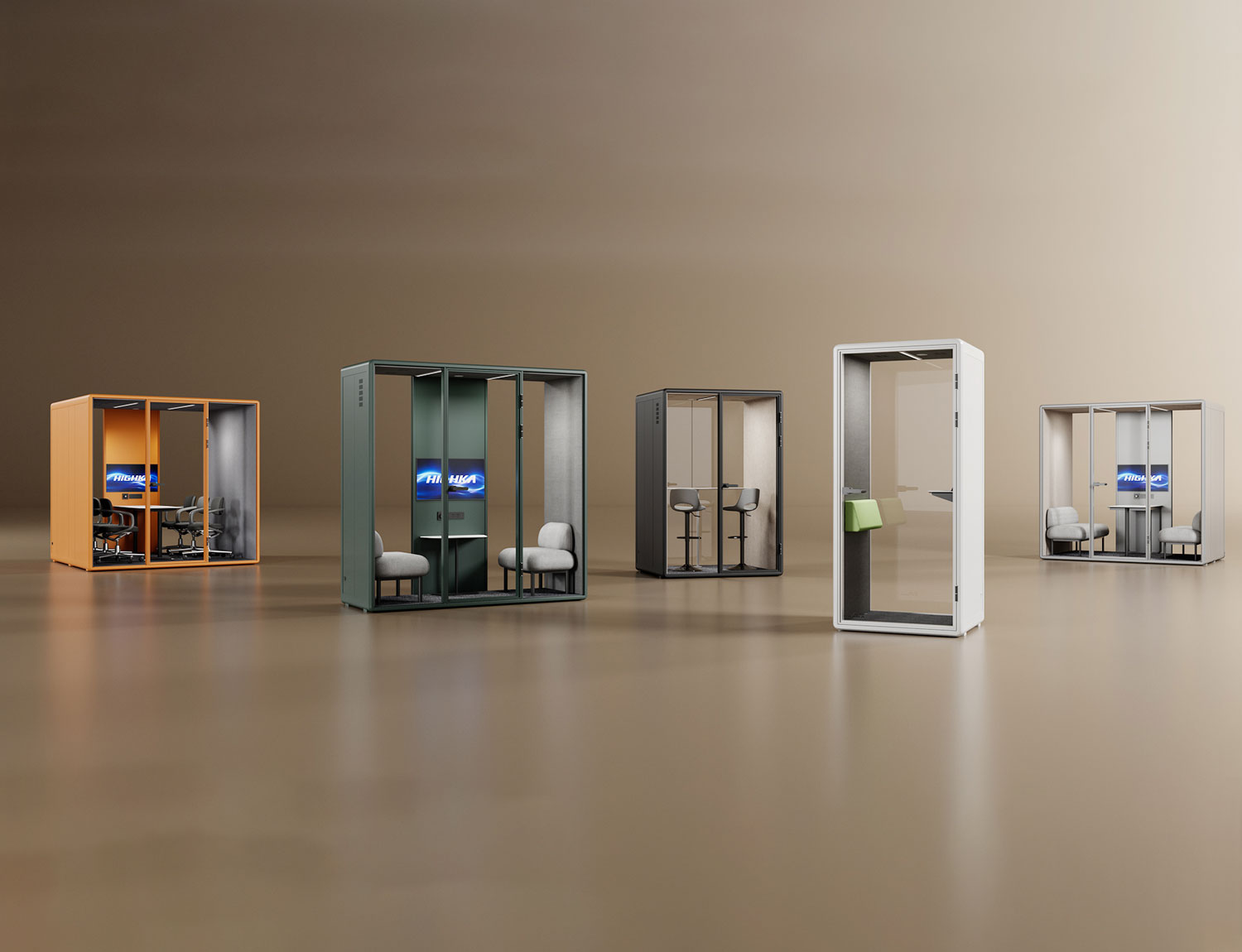
| Model | Capacity | Primary hybrid strategy function |
|---|---|---|
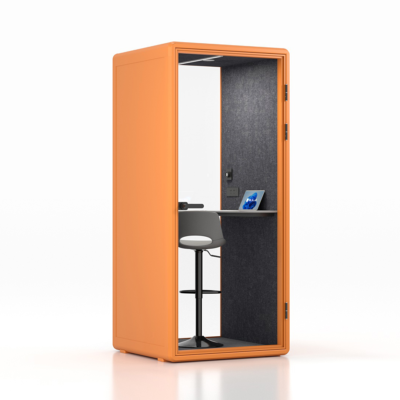
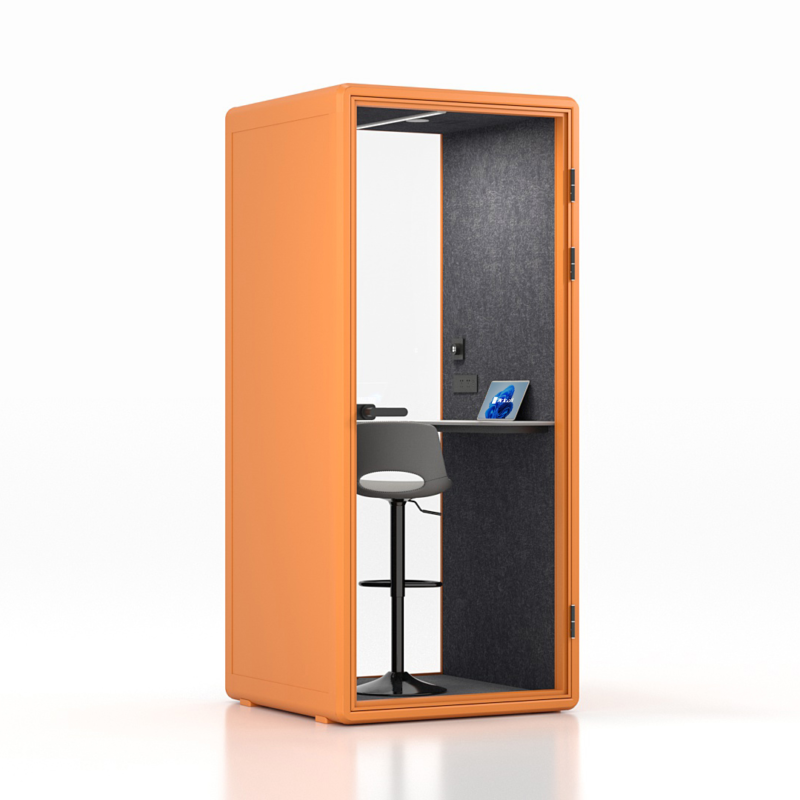
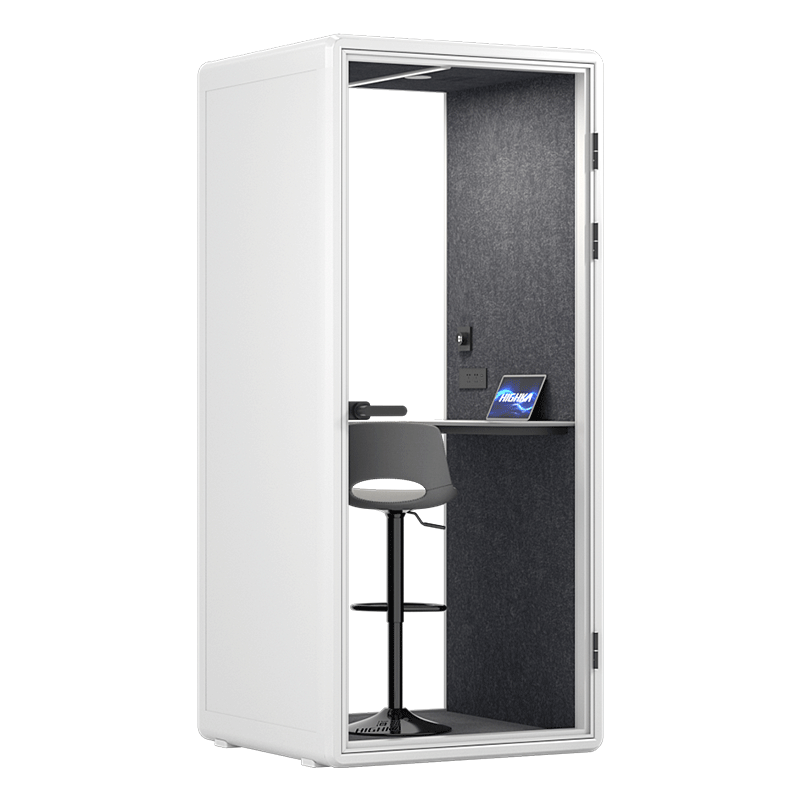
| Model S | 1 person | Individual focus work; private calls; video call studio |
| Model M | 1–2 persons | Confidential 1:1; paired work; bilateral client calls |
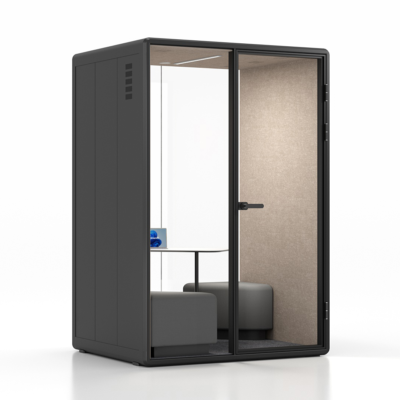
| Model SL | 2 persons | Private collaborative sessions; coaching; interviews |
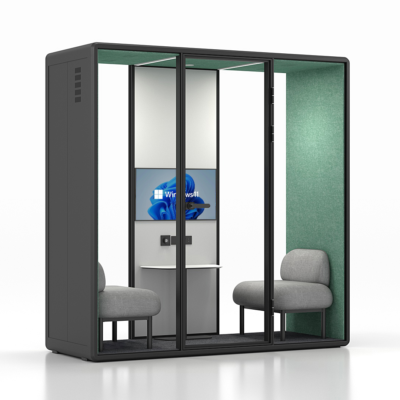
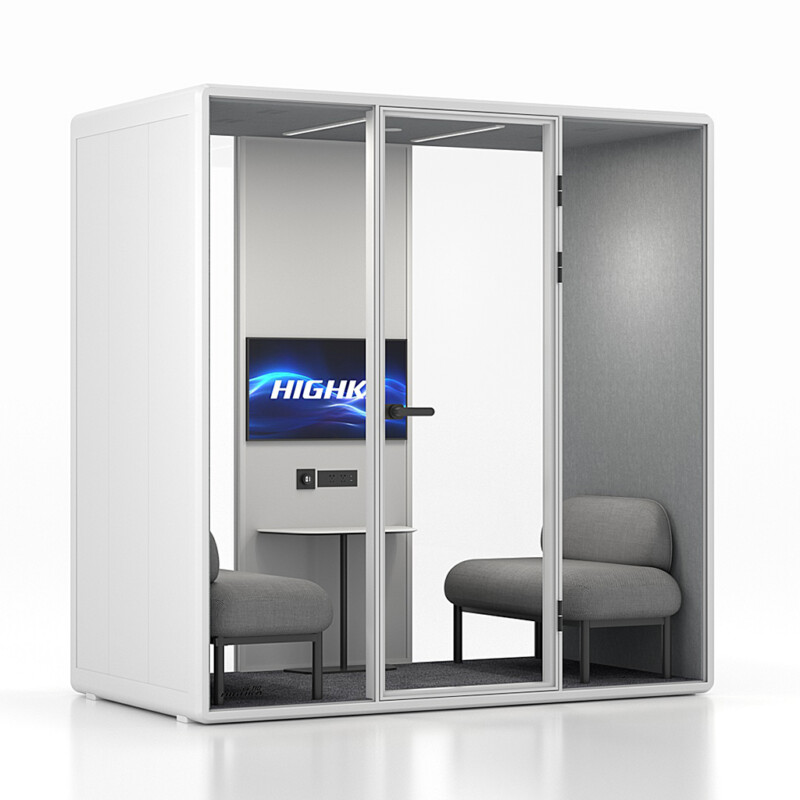
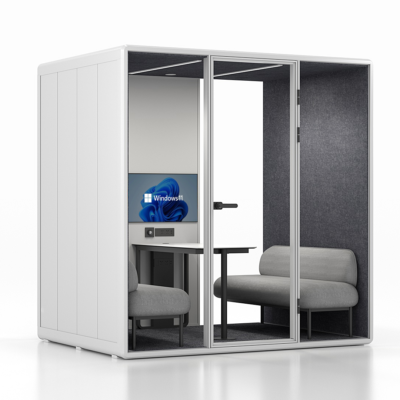
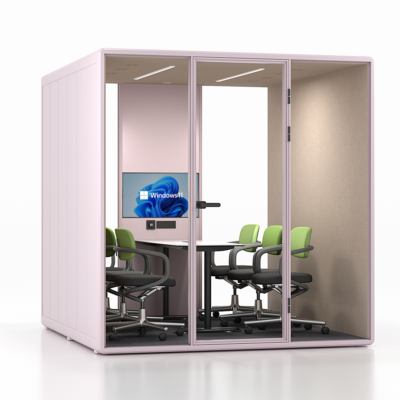
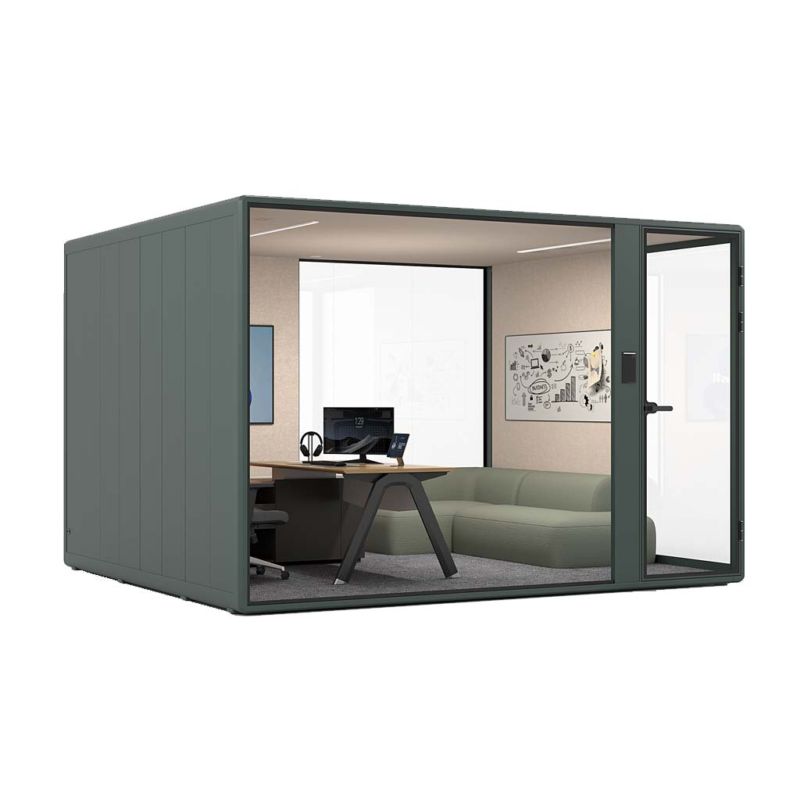
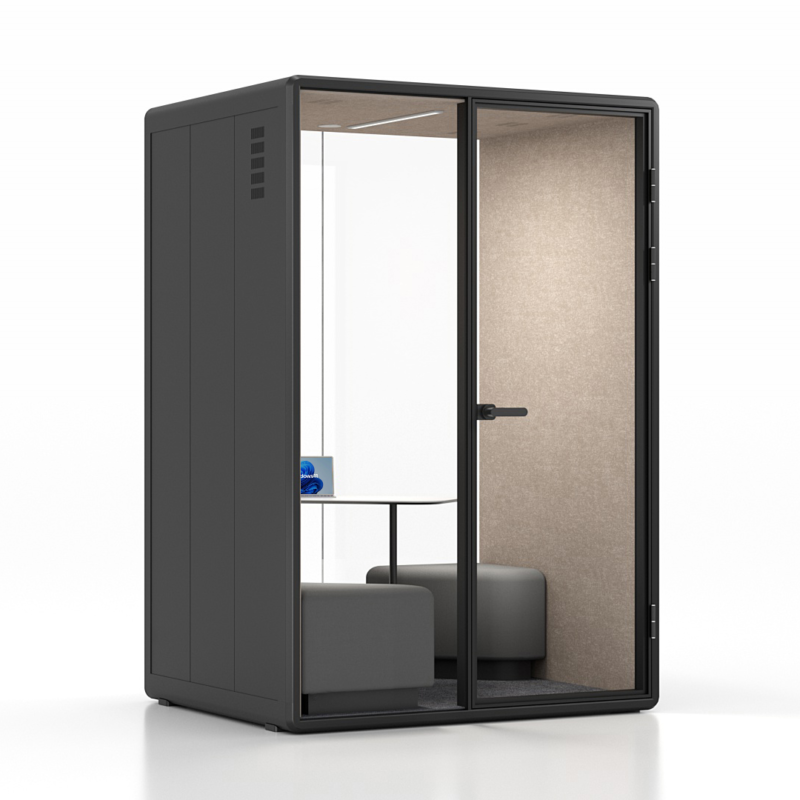
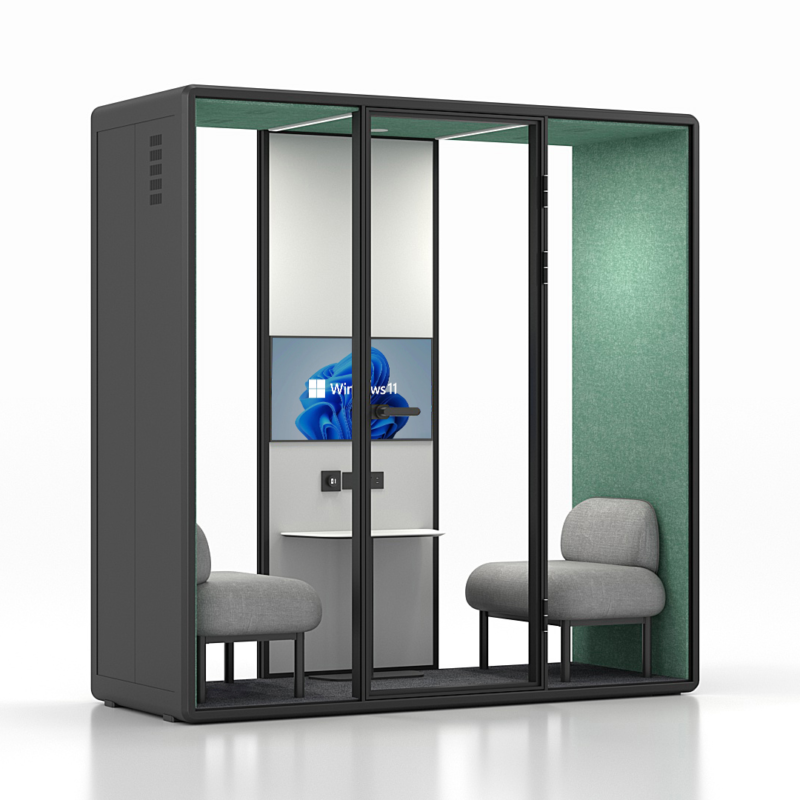
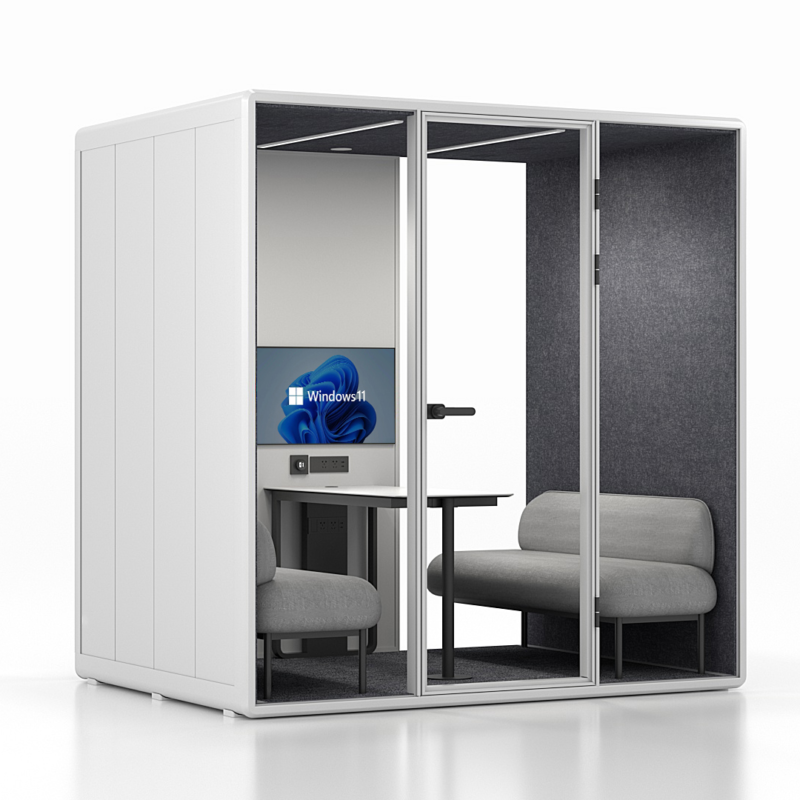
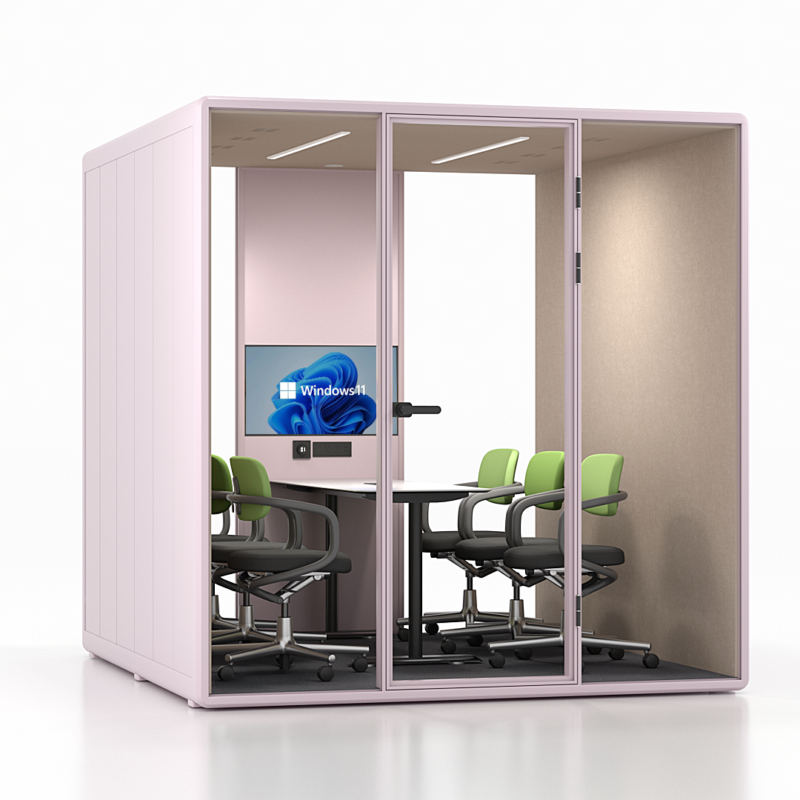
| Model L | 2–4 persons | Small team meetings; project discussions; group video calls |
| Model XL | 4–6 persons | Larger team sessions; hybrid meetings with group in-room |
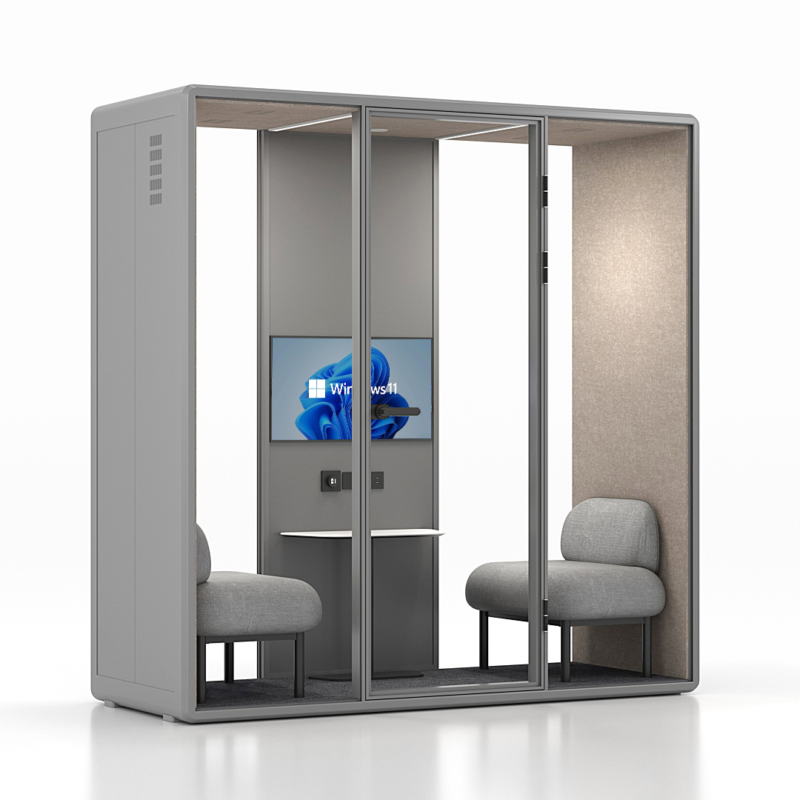
All models: DS,A = 29.4 dB (SGS/ISO 23351-1); HPL tabletop and high-density foam seating standard; 95% recyclable EU E1 formaldehyde compliant materials; CE, UL, ISO 9001, SGS certified; 8 exterior colour options; 8–12 year design lifespan; 50,000+ use cycle testing (key components); deployed in 50+ countries since 2012.
Keystone 5: Build an Acoustic Gradient — Open Collaboration Plus Enclosed Focus
The fifth keystone synthesises everything above into a physical design principle: the effective hybrid office provides a genuine acoustic gradient — not a single shared acoustic condition, but a designed spectrum of environments matched to the full range of cognitive tasks hybrid teams perform.
Why a single environment fails:
Different knowledge work tasks have different acoustic requirements. Writing and deep analysis require near-silence (ISE elimination). Small group decision-making requires moderate ambient with speech privacy. Social connection and creative collision benefit from the energised ambient of an open collaborative floor. A single acoustic condition — whether uniform open-plan or uniform enforced quiet — cannot serve all three. The office that forces all employees into the same acoustic environment on all tasks generates friction and productivity loss for the tasks that environment does not suit.
The acoustic gradient framework:
High-energy open zone (55–65 dB): The open collaborative floor — energised, socially connected, appropriate for the spontaneous interaction, relationship-building, and creative collaboration that generates the unique value of in-person office days. This zone requires no acoustic enclosure — it requires good passive treatment (panels, ceiling baffles) to reduce reverberation while preserving the ambient energy that makes it valuable.
Enclosed focus zone (< 35 dB): HIGHKA acoustic pods — certified near-silence for individual focused work, private calls, and the highest-demand cognitive tasks that are impaired by open-plan noise. This is the acoustic environment that home provides and most offices do not — and providing it is what makes the office worth choosing over home for a full day’s range of work.
Enclosed meeting zone: Multi-person HIGHKA pods providing bidirectional DS,A = 29.4 dB speech privacy for small-group discussions — containing meeting noise within the pod (protecting open-floor colleagues) and isolating open-floor ambient from meeting participants (enabling candid, focused discussion).
The gradient in hybrid strategy terms:
The acoustic gradient is the physical implementation of the hybrid strategy’s core design principle — that office days should provide the full spectrum of working conditions that makes the most important work possible. Open floor for collaboration and culture. Enclosed pods for the focused individual work and private professional conversations that home cannot consistently provide. The gradient removes the need to choose between office and home based on the day’s task type — because the office provides both.
The 2026 Hybrid Working Strategy Checklist
For organisations building or updating their hybrid working strategy, the following checklist operationalises the five keystones:
Keystone 1 — Employee-driven:
- Quarterly pulse survey measuring which tasks employees perform best in-office vs. remote
- Manager 1:1 check-ins focused on working conditions and physical environment quality
- Pilot programme with volunteer cohorts before full-scale policy launch
- Feedback loop that connects survey data to physical environment improvements within 60 days
Keystone 2 — Outcome measurement:
- Voluntary vs. mandated attendance rate tracked monthly
- Acoustic pod utilisation monitored (target: 40–70% at 30 days; >70% peak hours triggers capacity expansion)
- Employee self-report of focus time quality on quarterly surveys
- Meeting space right-sizing data reviewed quarterly
Keystone 3 — Voluntary attendance design:
- Office experience gap assessment: what does the office provide that home cannot?
- Open collaborative zones designed and activated
- Client-facing call infrastructure (enclosed pods with professional lighting) confirmed in place
- Spontaneous interaction infrastructure (social zones, casual meeting areas) active
Keystone 4 — Certified acoustic infrastructure:
- ISO 23351-1 DS,A specification confirmed for all enclosed acoustic spaces
- Independent accredited laboratory test certificate obtained and documented
- Pod count confirmed: minimum 1 per 10–15 knowledge workers as baseline
- Model mix confirmed: single/paired pods + small meeting pods + (if needed) larger meeting pods
Keystone 5 — Acoustic gradient:
- Open floor zone activated with passive acoustic treatment for reverberation control
- Enclosed focus zone (HIGHKA pods) available and accessible to all employees
- Enclosed meeting zone (multi-person HIGHKA pods) positioned for small-group use
- Zone transitions frictionless: employees can move between zones without booking friction for immediate use
Frequently Asked Questions
A hybrid working policy specifies the rules: who comes to the office, on which days, under which conditions. A hybrid working strategy specifies the outcomes: what the hybrid arrangement is intended to achieve (voluntary attendance, productive output, engagement, retention), how those outcomes will be measured, what physical and organisational infrastructure is required to deliver them, and how the strategy will evolve as data reveals what is and is not working. Policy without strategy produces compliance without commitment. Strategy without policy produces intention without clarity. The five keystones in this guide are the components of a complete hybrid working strategy — policy (Keystones 1 and 2) embedded within a broader strategic and physical infrastructure framework (Keystones 3, 4, and 5).
The research-supported baseline is one enclosed acoustic space per 10–15 knowledge workers. For a 40-person team, 3–4 pods in a mixed configuration is the minimum meaningful deployment: 2 single/paired pods (Model S or M) for individual focus work and private calls, and 1–2 small meeting pods (Model L) for 2–4 person discussions. Deploy at this baseline, monitor utilisation for 60 days, and expand when average peak-hour utilisation exceeds 70%. HIGHKA’s 1–4 hour assembly means capacity expansion does not require construction planning.
The sequencing that generates the most reliable outcomes: (1) Begin with employee listening (Keystone 1) before finalising any policy — 4–6 weeks of structured surveys and 1:1s. (2) Establish the measurement framework (Keystone 2) before strategy launch, so baseline data is captured. (3) Define the voluntary attendance design principles (Keystone 3) that will guide physical investment decisions. (4) Deploy acoustic infrastructure (Keystone 4) before or concurrent with the strategy launch — not after. The acoustic gap is the most common reason employees self-select away from the office; closing it first maximises the return on all other hybrid investments. (5) Validate the acoustic gradient (Keystone 5) through 30-day utilisation data and adjust pod deployment as needed.
The most consistent failure mode is the acoustic infrastructure gap — the strategy invests in policy, communication, and culture but not in the physical workspace quality that determines whether employees can do their most important work in the office. When hybrid employees experience the open-plan office as acoustically inferior to home for their most demanding tasks, they systematically avoid the office for those tasks — and in-person days generate collaboration and social connection but not the focused productive output that makes real estate investment worthwhile. Closing this gap requires certified enclosed acoustic infrastructure (ISO 23351-1 DS,A ≥ 25 dB, independently tested).
The Hybrid Strategy That Earns Attendance
The fundamental test of any hybrid working strategy in 2026 is simple: does your office earn the voluntary attendance of your hybrid team on their most important working days — or does it simply require it?
Strategies built on the five evidence-based keystones in this guide — employee-driven data, outcome measurement, voluntary attendance design, certified acoustic infrastructure, and acoustic gradient — create offices that hybrid employees actively choose. The choice is made because the office provides something home cannot: the combination of spontaneous, energised collaboration and certified acoustic quiet that makes a full day of varied knowledge work possible under one roof.
HIGHKA acoustic pods are the physical infrastructure of Keystones 4 and 5: DS,A = 29.4 dB (SGS/ISO 23351-1); strong upper speech frequency performance at 39.3/41.1/43.9 dB; continuous turbine ventilation; circadian lighting (0–1,800 lm, 3,000K–6,500K, CRI 90, UGR <20); microwave radar sensing; HPL tabletop and foam seating included; 95% recyclable EU E1 materials; CE, UL, ISO 9001, SGS certified; five models (S/M/SL/L/XL); 8 exterior colours; 50+ countries; 8–12 year lifespan; 1–4 hour assembly; no permits.
Ready to build the acoustic infrastructure that completes your hybrid working strategy?
👉 Request a free hybrid strategy acoustic assessment and HIGHKA pod configuration
Share your team size, current attendance patterns, and hybrid strategy challenges. We’ll recommend the right pod configuration to complete your acoustic infrastructure — at no obligation.